This week's selection has something for everyone: an algorithm that triages mammograms, a patch that uses ultrasound to regulate heart rhythm, a sensor that monitors brain fluid, and 50% off tickets at the Longevity Show.
Mirai: AI Triage for Breast Cancer Screening
A joint workflow study from University of California, San Francisco and University of California, Berkeley ran an open-source model called Mirai across more than four thousand screening mammograms. The workflow "identified 525 women (about 12.7%) as high risk" and routed them into an accelerated pathway. The study "reduced diagnostic evaluation wait times from several weeks down to approximately one hour," and for those eventually diagnosed, "the average wait for a biopsy plummeted from over two months to fewer than 10 days." Mirai does not replace the radiologist or issue a diagnosis. It is a prioritisation layer that decides who is seen first.
The Ultrasound Pacemaker Patch
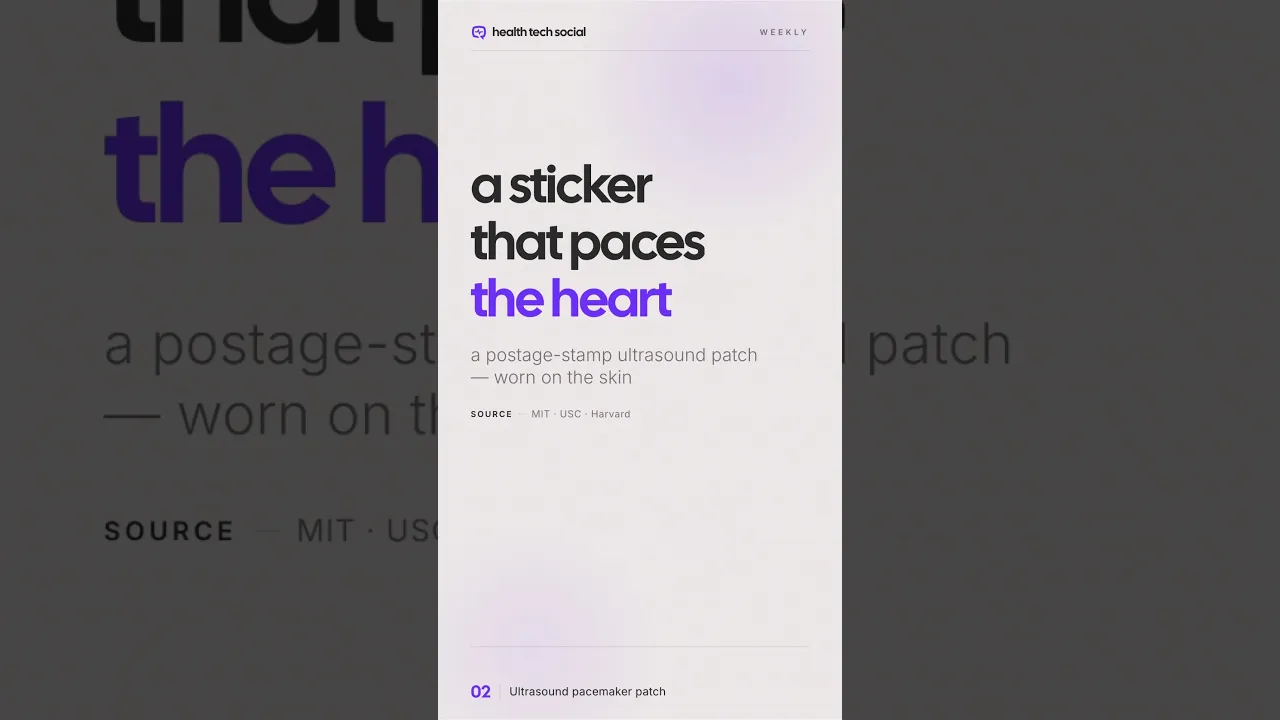
A team from Massachusetts Institute of Technology, University of Southern California and Harvard University has built a postage-stamp-sized ultrasound sticker that paces the heart without surgery. It relies on sonogenetics: cardiac cells are engineered to express ion channels that open in response to ultrasound, triggering contraction. This has been trialled in rats, where the patch corrected arrhythmias and restored regular rhythms.
The work is currently at preclinical stage, and a clinical version would necessitate a one-time gene therapy treatment to sensitise the patient's cardiac cells to ultrasound. It is a promising mechanism with a long regulatory road ahead.
NeuroSense: Continuous CSF Monitoring
A team led by the University of Waterloo has developed NeuroSense, a device that connects to brain drainage lines and monitors cerebrospinal fluid continuously, tracking glucose, lactate, fluid pH and physical flow rate. Current practice samples fluid manually, roughly once every day or two. This study recognises that up to 20% of patients requiring external brain drains experience infections, some of which are severe such as meningitis, which can more than double hospital stays.
What connects a triage algorithm, a cardiac patch, and a brain fluid sensor is not the technology itself, but the gap each one is trying to close: the time between a problem developing and someone finding out. Mirai has already closed that gap for breast cancer screening. The other two are attempts to close it for arrhythmias and for intracranial complications. All worth watching.
Health Tech Social Partners With The Longevity Show
We've partnered with The Longevity Show , the UK's first dedicated longevity festival, to give Health Tech Social readers 50% off festival tickets and industry access B2B tickets.
CODE: HTS50
On 26 to 27 June, Tobacco Dock London hosts two days of diagnostics, wearables, and preventative health, with a dedicated track for anyone building, investing, or working in this space. If that's you, here's what's relevant:
The Assessment Lab & Diagnostics – Live metabolic tracking, health testing, and AI-powered screening tools.
The Wearables & Innovation Expo – Hands-on access to current monitoring and recovery technology.
The Dedicated B2B Conference – Direct access to the founders, investors, and clinicians working in preventative health.
Speaker Programme – Talks from medical experts and wellness names including Dr Rangan Chatterjee, Joe Wicks, Davina McCall, Fearne Cotton, Grace Beverley, Liz Earle MBE, Dr Megan Rossi, Jacqueline Hooton, Leanne Hainsby, Jamie Bigg, and Lara Lewington.
As an official Media Partner, we've secured 50% off festival tickets and industry access B2B tickets!
Use code HTS50.
Tickets: https://longevityshow.com/get-tickets/
Sources:
UCSF/UC Berkeley
MIT/USC/Harvard
University of Waterloo
Further reading:
This post is for informational purposes, and is not medical advice.
Follow Health Tech Social for more health tech insights.
TikTok | LinkedIn | Instagram | YouTube | healthtechsocial.com
Want to be featured on Health Tech Social? Let's collaborate!
Message or email us at info@healthtechsocial.com