Your Wearable's Heart Rate and HRV Reading Might Be Lying to You
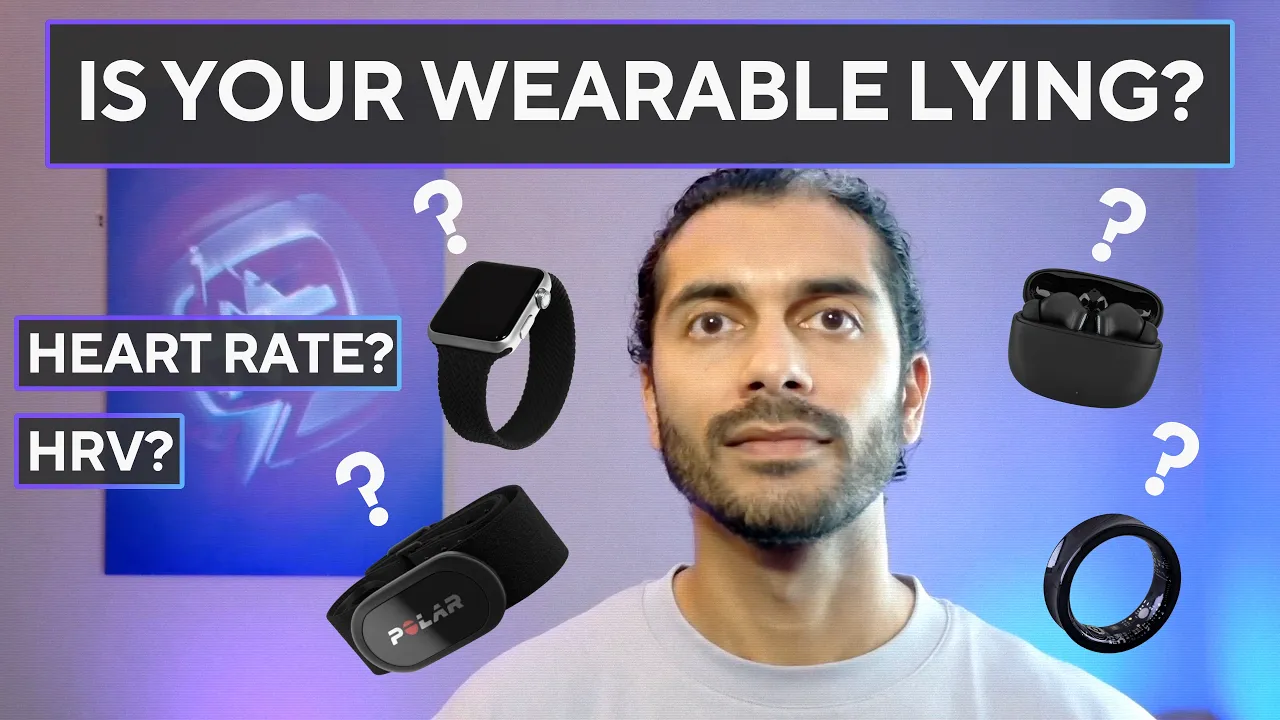
This week's video looks at four wearables, chest straps, smartwatches, biometric earbuds and smart rings, and how accurate each one actually is.
This week's video looks at four wearables, chest straps, smartwatches, biometric earbuds and smart rings, and how accurate each one actually is.
Watch the full video and subscribe on YouTube
This week's video looks at four wearables, chest straps, smartwatches, biometric earbuds and smart rings, and how accurate each one actually is. None of them are generally "bad." They're just good at different things, and this video helps you decide which one is worth buying (watch on YouTube).
The Polar H10 chest strap remains the reference every other device gets measured against. Multiple peer-reviewed studies, including one published this year, put its correlation against hospital-grade ECG above 0.99, about as close to a perfect match as this kind of comparison gets. This precision makes it the best option for tracking HRV during activity. HRV, heart rate variability, the tiny differences in timing between individual heartbeats, is often used as a marker of recovery and stress on the nervous system. The catch: it has to sit snug against bare skin for a clean reading, and Polar's own care instructions call for rinsing it after every session. Some users complain it can chafe and feel uncomfortable, though at least it comes with roughly 400 hours of battery life. Is the accuracy worth the inconvenience?
A 2020 study by Kinnunen and colleagues published in Physiological Measurement found the Oura Ring's overnight correlation against ECG at 0.996 for heart rate and 0.980 for HRV, both close to a perfect match, provided the hardest thing you're doing is sleeping. Start a workout, though, and that accuracy comes apart. Gripping anything, like a barbell or a dumbbell, compresses the same finger capillaries the sensor depends on. Additionally, the ring's tiny battery forces it to sample less often through the day. They look cool, although did you know most of the major brands don't support contactless payments? Weird.
A 2025 study in JMIR Cardio comparing an upper-arm optical sensor against a wrist-worn smartwatch found the arm-worn device was more accurate, off by under 1.5 beats per minute on average. Whereas the wrist-worn device was off by more than 6 beats per minute. It really comes down to how much the sensor moves.
Smartwatches are genuinely excellent for continuous daily tracking: steps, notifications, steady cardio like walking or running. The problem is the one job most people actually bought them for, tracking effort during a workout, which is exactly where wrist-worn devices get awkward.
Sennheiser's Momentum Sport adds a core body temperature sensor alongside heart rate. Apple's AirPods Pro 3 pulse infrared light into the ear canal 256 times a second. Both benefit from the same thing: ear canal skin barely moves during exercise. They work well, as long as they fit. Which is why an ear-hook, like the one on the Powerbeats Pro 2, isn't just design, it's function.
Go for the Polar H10 (chest strap) if you want the most accurate reading possible, you're doing high-intensity intervals or sprint training, or you're tracking detailed recovery data through HRV.
Go for biometric earbuds if you already train with music and want solid accuracy during a workout without a chest strap or a smartwatch.
Go for a smart ring if your main priority is sleep tracking, spotting illness early, and recovery data, without wearing anything on your wrist to bed.
Go for a smartwatch if you want one device that covers everything else: daily vitals, notifications, step counts and steady outdoor runs.
Full breakdown is in the video.
Let us know in the comments below.
Message us at Health Tech Social
LinkedIn | TikTok | Instagram | YouTube | healthtechsocial.com | Apple Podcasts | Spotify
Chung, V. et al., "Validity of the Polar H10 for Continuous Measures of Heart Rate and Heart Rate Synchrony Analysis," Sensors, 2026: https://www.mdpi.com/1424-8220/26/3/855
Kinnunen, H. et al., "Feasible assessment of recovery and cardiovascular health: accuracy of nocturnal HR and HRV assessed via ring PPG in comparison to medical grade ECG," Physiological Measurement, 2020: https://iopscience.iop.org/article/10.1088/1361-6579/ab840a
"Wrist-Worn and Arm-Worn Wearables for Monitoring Heart Rate During Sedentary and Light-to-Vigorous Physical Activities: Device Validation Study," JMIR Cardio, 2025: https://cardio.jmir.org/2025/1/e67110/
Polar H10 battery specifications, Polar's official product page: https://www.polar.com/us-en/sensors/h10-heart-rate-sensor
This post is for informational purposes, and is not medical advice, a paid promotion or endorsement.